Below are details of correspondence between a Cilycwm family and Natural Resources Wales in April 2026 regarding proposed plans for the Upper Tywi Valley….Islaw gweler gohebiaeth rhwng teulu o Gil-y-cwm a Chyfoeth Naturiol Cymru yn Ebrill 2026 ynghylch cynlluniau arfaethedig yn y rhan Uchaf o Ddyffryn Tywi.
Thank you for your emails of 28 February 2026 and 9 March 2026. We recognise the time you have taken to set out your concerns in detail and we have carefully reviewed the points you raise. Your correspondence has been discussed with colleagues who originally provided technical advice on these proposals.
Our role in the planning system is that of a Statutory Consultee providing specialist advice on matters within our defined remit, including potential impacts on peat soils, peatland habitats, hydrology, and the natural environment. As you are aware our function is to provide technical input to inform the decision-making process, rather than to determine the overall acceptability of development proposals, which rests with the determining authority. Other statutory bodies, including Cadw, also have a role and their advice will form part of the overall evidence considered by the determining authority.
In relation to your concerns about the scale and nature of construction activity associated with large wind turbine developments, including turbine foundations, crane hardstanding’s, access tracks, vehicle movements and construction sequencing, we recognise that these works may result in substantial ground disturbance and carry risks for sensitive environments such as peatland. Consideration of construction impacts, including the potential permanence of disturbance arising from works described as “temporary”, is therefore an important component of environmental assessment. Within our role, we focus on whether developers have adequately identified and assessed such impacts on peat soils and peatland habitats, and whether avoidance, mitigation and management measures are consistent with Planning Policy Wales (Edition 12), including application of the Stepwise Approach.
With regard to cumulative impacts, for the majority of cases reviewed by us to date, potential impacts relate to discrete peatland units with no perceived functional dependence on peatland units included within other development proposals. Such a functional dependence may arise where two or more developments affect the same peat body that would be expected to support a linked hydrological regime. In such a scenario, we would assess the resulting cumulative impact and provide advice on the adequacy and implications of that assessment.
Our position is that development proposals should avoid peat soils and peatland habitats on peat soils, in accordance with Planning Policy Wales (Edition 12) paragraphs 6.4.34 and 6.4.15.1b respectively. This policy requirement applies to each individual application and is not dependent on the presence of a cumulative assessment. We acknowledge your point that, while Planning and Environment Decisions Wales act as the decision‑maker, our role as a statutory consultee is to provide expert evidence and advice to inform those decisions. Where there is a reasonable expectation of cumulative environmental effects within our remit, including impacts arising from shared peat bodies or linked hydrological systems, we do consider and advise on those cumulative impacts as part of our technical consultation response. Our advice is therefore not limited to proposals considered in isolation where evidence indicates functional interaction. The scope and level of cumulative assessment required is informed by the nature of the receiving environment, the degree of functional connectivity demonstrated, and the requirements set out in national planning policy. It is for the determining authority to consider whether developments which pose these impacts are ultimately acceptable, either individually or in combination.
You also raise concerns regarding our duties under Section 6 of the Environment (Wales) Act 2016 and the Well‑being of Future Generations (Wales) Act 2015. We are required to exercise our functions in accordance with these duties and do so through our statutory and regulatory roles, including the provision of expert technical advice in the planning process, the application of national planning policy, and our wider programme of work to protect, manage and restore peatland ecosystems. In the context of planning consultations, this work is undertaken within the framework established by legislation and policy, with responsibility for balancing environmental considerations against other material considerations resting with the decision‑maker.
You have also queried whether our storm recovery and forest management works could be used to facilitate future wind farm development. Our recovery and maintenance activities are undertaken to address damage arising from extreme weather events and to ensure safe and effective land management. These works are planned and delivered independently of renewable energy proposals and do not pre‑determine, enable or authorise future development. Any use of access routes or infrastructure beyond their intended purpose would be subject to the appropriate planning and regulatory controls.
We share your concerns about further loss or degradation of peatland habitats. With support from Welsh Government funding, we have invested in developing specialist technical capacity to strengthen the assessment of potential impacts on peat as part of our wider National Peatland Action Programme work.
We hope the above clarifies our role and approach and demonstrates that the issues you have raised have been carefully considered within the scope of our statutory responsibilities.
Kind regards,
Tîm Cynllunio Datblygu / Development Planning Team
Cyfoeth Naturiol Cymru / Natural Resources Wales
The response………Thank you for your helpful email of 16th April explaining NRW’s position regarding the assessment of cumulative impact when advising on strategic planning applications.
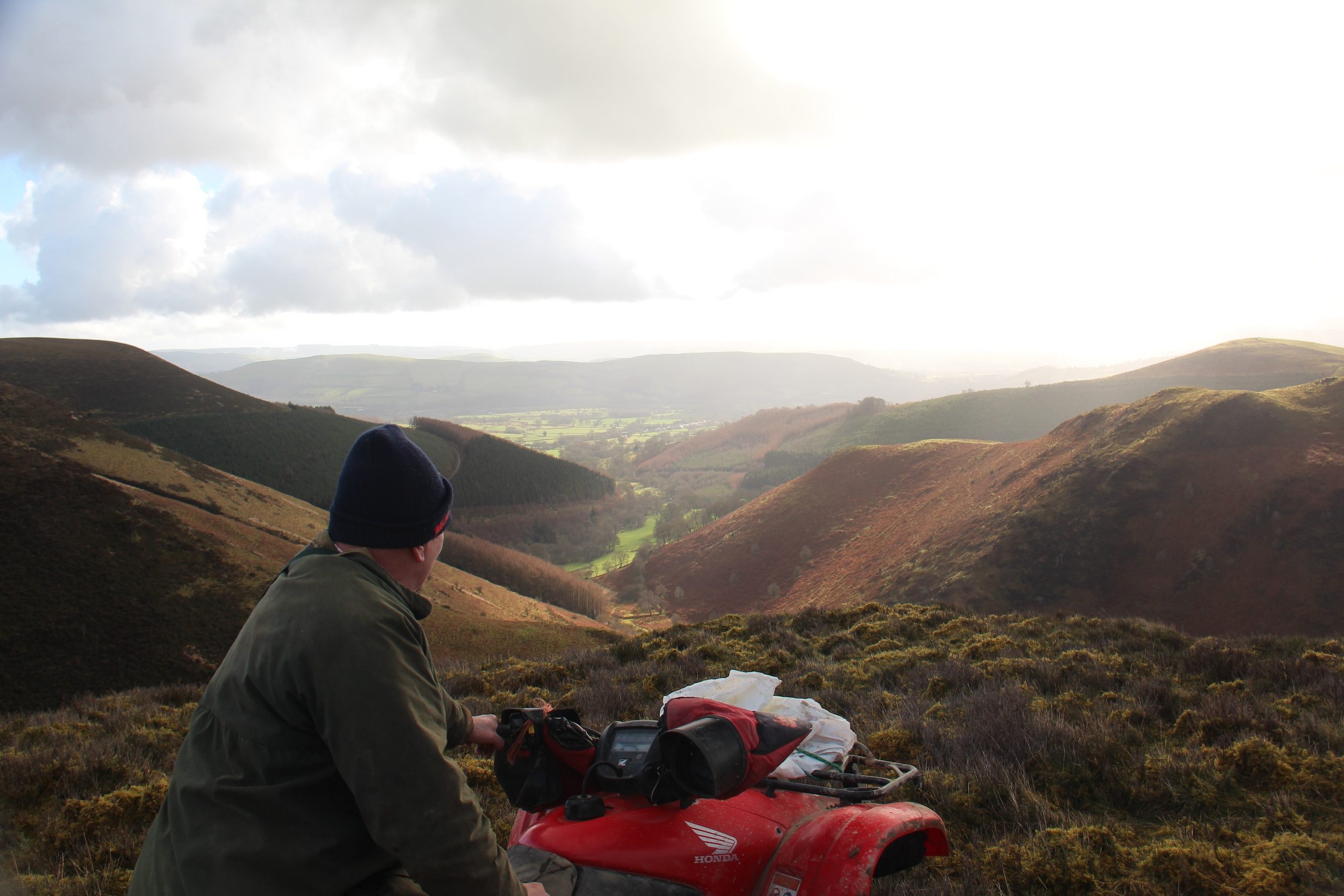
The Bryn Cadwgan application is for development on peatland, but it is not a discrete peatland unit. It is one of the four sites designed to form a box like shape on the same infrastructure on the same upland plateau. Bryn Cadwgan sited to the south (developer Galileo), Lan Fawr immediately to the north and east of Bryn Cadwgan (developer Bute Energy), Bryn Rhudd 2km northwest of Lan Fawr (developer Bute…both their sites being presented as a pair in the consultation papers), and Waun Maenllwyd sited to the west (developer Belltown Power).
You refer to functional dependence; the physical and functional interaction between these sites is clear. All sites propose to use the same common access route at Pumsaint, and the same main track to their individual sites, and if permitted will form four linked industrial blocks. Their proximity on the plateau and the hydrological regime means that they have a cumulative impact, even if each planning application is considered in isolation. I do not have access to detailed maps showing all sites and the various watercourses, however, I can see that Pysgotyr and its tributaries appear to rise in the peat bogs where Bryn Cadwgan and Lan Fawr meet. Therefore it is essential that the NRW advice covers the functional interaction and stresses the hydrological connectivity of the Bryn Cadwgan application to the other sites. If you drain or excavate one section, the entire system is compromised.
In respect of Bryn Cadwgan, the applicant has compiled a draft peat management report. Paragraph 4.2.1.1 of that report states that specific options for mitigating effects on peat and its hydrology will only be defined ‘post-consent’. Whilst they list potential options, they do not actually commit to using them—essentially asking for a blank cheque. Furthermore, the claim that excavated peat will be re-used—likely only in borrow pits, because of the site design—leads the report’s authors to the conclusion that the peat replaced will be greater than that excavated. This ignores the biological reality of the life of acrotelm (the living surface layer) and composition of catotelm (the deep, wet carbon store). As NRW well knows, you cannot simply dig up the bottom layer of peat, dump it in a pit, and claim you’ve replaced a functioning bog.
I am aware that studies conducted in Scotland on blanket bog resulted in a finding that wind turbines create a localised microclimate. Further and more recent studies in China, dealt with the drying effects on ground surface. A 230m turbine would create considerable turbulence, effectively wicking moisture out of the ground, and on peatland eventually drying out the surrounding bog.
When you evaluate the damage caused by the physical excavation and construction footprint; combine this with the sheer impracticalities of re-using the disturbed peat and then add in the potential desiccating effect of the turbines, the evidence and argument against permitting wind farms on peatland appears insurmountable.
I appreciate that NRW is in a difficult position, balancing competing pressures, but I am heartened by your clear statement that development proposals should avoid peat soils and peatland habitats on peat soils. I hope that in the final response to the Bryn Cadwgan application, NRW will stand firm on this principle. Once this unique plateau is opened up, the damage to its hydrology and carbon-storing capacity cannot be undone.